

Introduction: How Many Homes Should You See Before Buying?
How many homes should you see before buying? For most move-up families in Markham, eight to twelve. Not 40.
That number surprises people. It surprised me too, and I’ve been licensed since 2008.
The typical buyer sees seven homes over about ten weeks. That comes from the National Association of REALTORS 2025 Profile of Home Buyers and Sellers, published November 2025. Same report, different number: 56 percent of buyers said finding the right property was the hardest part of the entire process. Not the financing. Not the paperwork. Finding it.
So the average buyer sees seven homes and still finds the search brutal. Which tells you something useful. The problem was never how many homes you see. It’s what happens before you book the first one.
Here’s what I changed, and why my clients now decide faster and second-guess less.
Why does seeing more homes make the decision harder?
Because every home you add becomes a comparison you have to carry.
See eight homes and you’re comparing eight things. See 40 and you’re comparing 40, except you aren’t, because you don’t remember house number six by the time you’re standing in house number 31. What you remember is a blur of kitchens.
Researchers call this choice overload. The best known study is Iyengar and Lepper’s jam experiment, published in the Journal of Personality and Social Psychology in 2000, where shoppers offered six options bought far more often than shoppers offered 24. The research since then has been mixed and I’m not going to oversell it. But 18 years of watching families make this exact decision has been consistent. The families who see the most homes are not the most confident buyers. They’re the most exhausted ones.
Exhausted buyers do one of two things. They stall, or they settle. Neither one is a search problem. Both are sequencing problems.
How many homes are actually for sale in Markham right now?
Fewer than you would guess, and that changes the math on all of this.
In July 2026, Markham had 1,168 active listings across every home type and every price point, against 288 sales for the month. That’s from TRREB’s Market Watch for July 2026. Across the GTA, new listings that month were down 17.8 percent year over year and active listings were down 12.1 percent. Markham is also carrying about 4.2 months of inventory, one of the tighter positions in York Region.

1,168 sounds like an ocean. Then you start filtering.
Take a family who needs a detached home, in a specific school catchment, inside the price band their Move-Up Math actually supports, with a layout that works for two kids and someone on video calls all day. That 1,168 collapses quickly. Not to 40. Usually to somewhere between a dozen and two dozen homes that genuinely qualify, and a handful worth giving up a Saturday for.
At 4.2 months of inventory, the homes that fit a specific brief don’t sit around waiting while you tour the ones that don’t.
Which problems can a renovation fix, and which ones can’t?
This is the filter that does the most work, and almost nobody sets it up before they start looking.
Before you open a single listing, split your list into two columns. What a renovation can fix, and what a renovation can never fix. Then treat the second column as non-negotiable and the first column as a budget conversation.
| Fixable with money and time | Not fixable at any price |
|---|---|
| Kitchen and bathroom finishes | Commute time |
| Flooring, paint, lighting | Lot size and yard depth |
| Basement finish | School catchment |
| Closets and storage build-outs | Which street you are on |
| Some layout changes, with permits | Traffic volume and noise |
| Landscaping and curb appeal | Neighbours and street feel |
Most families I meet have this backwards. They rule out a home because the kitchen is dated, then book a second showing on a house with a 40 minute drive to their kids’ weeknight activities, because the finishes were nice.
That’s the whole point of the renovation trap, and it works just as well as a search filter as it does as a reason not to renovate.
Right column non-negotiable. Left column negotiable. Do that honestly and your shortlist starts writing itself.
What’s the difference between a volume search and a filtered search?
One of them sorts homes. The other sorts criteria. That single difference is why one takes six weekends and the other takes two.
| Volume search | Filtered search | |
|---|---|---|
| Criteria decided | After viewing, if ever | Before the first showing |
| Homes viewed | 30 to 40 | 8 to 12 |
| Each home compared against | Every other home you saw | A written standard you both agreed on |
| Who does the filtering | You, on weekends | Your agent, on weekdays |
| Common outcome | Fatigue, then stalling or settling | A decision you can still defend in a year |
What does a smarter home search look like, step by step?
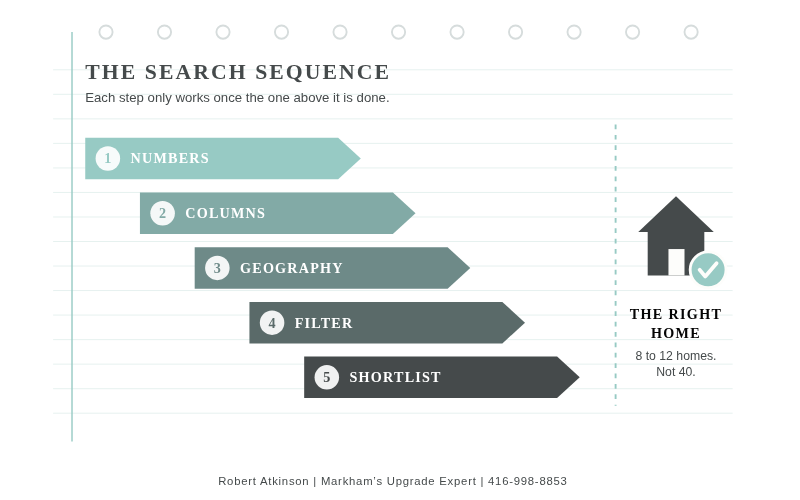
Five steps. The order matters more than the steps do.
- Run the numbers first. Not your sale price. Not your purchase price. The gap between them. The net cost to move up is the number that sets your real search band, and it is almost always different from the one families assume.
- Write the two columns. Fixable and unfixable, from the table above. Both partners write their own list separately, then compare. That conversation is worth more than ten showings.
- Set the geography before the house. Catchment, commute, and the drive to whatever your family does on a Tuesday night. In Markham your catchment is set by your exact address, and two houses across the street from each other can feed different schools.
- Let me filter. This is the part that used to be your job and should not be. I look at everything that comes on. You see what survives the two columns. That is usually three to five homes per outing, not eleven.
- Book the shortlist, not the market. Eight to twelve homes total, across two or three outings, with a real debrief after each one while it is still fresh.
Think about it the way you’d think about a good travel guide. A guide who marches you through every restaurant in a city isn’t being thorough. They’re just not doing their job. You hired them because they’ve already eaten everywhere, and they know which four places you’ll actually love.
How do you know when you’ve seen enough homes?
When a home clears both columns and you’re still looking, you’re not searching anymore. You’re avoiding.
Here’s the test I use. If a home satisfies every item in your unfixable column, sits inside the band your Move-Up Math supports, and only needs work that lives in the fixable column, you’ve found it. Seeing eleven more will not produce a better answer. It will produce a more tired one.
The other version matters too. If you’ve seen twelve homes and nothing has cleared both columns, the problem isn’t the market. It’s the columns. Something in there is wrong, contradictory, or priced somewhere your budget doesn’t reach. That’s a 20 minute phone call, not another six Saturdays.
And if you stay where you are, you already know that’s the wrong choice. That’s why you started looking in the first place.
Frequently asked questions about how many homes to see
Is seeing only eight to twelve homes risky?
Less risky than seeing 40. Risk comes from buying without a standard, not from viewing a smaller number. Eight homes measured against written criteria gives you a far better decision than 40 homes measured against each other.
How long should the search take?
The NAR 2025 Profile puts the median search at about ten weeks. With criteria set up front, most of my move-up families are on a shortlist inside three to four weeks. The setup takes a week. The search gets shorter because of it.
What if my partner and I want different things?
Then you find that out on paper in an afternoon instead of in a driveway in week five. Separate lists, then compare. Disagreements almost always sit in the fixable column, which means they are a budget question, not a dealbreaker.
Should I look at homes online before we meet?
Look all you want. Just don’t book anything yet. Online browsing before criteria is how a search picks up phantom must-haves that nobody actually needs.
Does this work if I am buying and selling at the same time?
It works better. Selling and buying together is a logistics puzzle with a sequence, and a tight shortlist is what makes the sequence possible. Fewer showings means more of your energy goes into the timing of the two deals.
What if nothing on the shortlist works?
Then we adjust the columns, not the effort. Usually one criterion is doing too much work, or the price band and the must-haves are pointing at two different markets. That is a fixable conversation.
How many homes do people usually see in Markham specifically?
TRREB does not publish a homes-viewed figure by municipality, so I will not pretend there is a local number. What I can tell you is what Markham gives you to work with: 1,168 active listings across all types in July 2026, and about 4.2 months of inventory. Filtered properly, most families are choosing between a dozen serious options.
Do I need to see a home twice before offering?
Usually yes for the one you’re serious about, and usually no for anything else. A second showing on a home that failed the unfixable column is a way of talking yourself into something.
Ready to cut your search down before it starts?
If you’re staring down a home search and dreading it, that’s the conversation to have before you book a single showing. Not after six of them.
I’ve been doing this in Markham for 18 years. I’ll sit down with you, run your Move-Up Math, and build your two columns with you. No pitch, no pressure, and if the answer is that this isn’t your year, I’ll tell you that too. Call or text me at 416-998-8853.
Let’s build your two columns.
DM me SHORTLISTSources: National Association of REALTORS, 2025 Profile of Home Buyers and Sellers, published November 2025. Toronto Regional Real Estate Board, Market Watch, July 2026. Iyengar and Lepper, Journal of Personality and Social Psychology, 2000.
